
When a CPA firm needs more capacity, the instinct is usually to open a job posting. But in 2026, there are more ways to solve a capacity gap than adding another full-time employee.
🔄The Hiring Reflex
A new client signs.
The partner is excited about the growth, but then comes the question:
“Who is going to do the work?”
The team is already busy. Managers have review queues. Senior accountants are stretched across multiple engagements. The partner doesn’t want to pull another person into the team just to keep up with the additional workload.
So the job posting goes up.
This is a familiar cycle for many accounting firms. More clients create more work, more work creates a capacity gap, and the default answer is to hire.
But hiring is only one way to create capacity.
And sometimes, it isn’t even the right one.
The more important question is:
What kind of capacity does your firm actually need?
📈When More Work Doesn’t Necessarily Mean More Employees
Not every increase in workload is permanent.
A firm might have a large bookkeeping engagement starting this quarter. Another might be preparing for tax season. A growing CAS practice may suddenly have more monthly work than its existing team can absorb.
The workload has increased, but that doesn’t automatically mean the firm needs another permanent employee.
Before deciding to hire, it helps to look at the work itself.
Ask:
Is this workload going to remain consistent for the next 12–24 months?
Does it require someone to be physically or organizationally embedded in the firm?
Does the work require significant client interaction or professional judgment?
Or is it largely repeatable production work that can be standardized?
Those answers can change the staffing decision considerably.
A firm doesn’t necessarily need another employee.
It needs the right amount and type of capacity.
💰The Cost of Hiring Isn’t Just the Salary
The obvious cost of a new hire is compensation.
The less obvious costs can be just as important.
Recruiting takes time. Onboarding takes time. Managers have to train and review the new employee’s work. It can take months before someone is operating at the level the firm needs.
And there is another consideration that doesn’t always make it into the hiring conversation: what happens if the workload changes?
Suppose a firm hires because it has eight months of unusually high demand. What happens when that demand normalizes?
The firm is then carrying a permanent cost for a temporary capacity problem.
That’s why the decision shouldn’t simply be:
“Can we afford to hire?”
It should be:
“Does this workload justify a permanent role?”
🔀A Simple Example: Same Problem, Different Solutions
Imagine a 20-person CPA firm that wins several new clients.
The additional work requires roughly two full-time equivalents for the next six months, but the firm’s leadership isn’t sure whether the workload will continue at that level afterward.
There are several ways to respond.
Option 1: Hire two full-time accountants.
This provides dedicated capacity, but also creates a long-term employment commitment.
Option 2: Ask the existing team to absorb the work.
This avoids immediate hiring costs, but increases the risk of burnout, slower turnaround, and senior staff getting pulled into production.
Option 3: Add flexible accounting capacity.
The firm keeps client relationships, oversight, and higher-level judgment in-house while adding support for the repeatable production work.
None of these approaches is automatically right.
The point is to stop treating every capacity gap as a hiring problem.
🏠What Should Stay In-House?
This is where the conversation becomes more useful.
Instead of asking whether to outsource the entire accounting function, start by separating the work.
Some responsibilities are closely tied to the firm’s client relationships and professional judgment. Others are highly repeatable and process-driven.
For many firms, the work that benefits from staying close to the core team includes:
Client relationships and communication
Advisory conversations
Complex tax and accounting decisions
Final review and quality control
Business development
Strategic planning
Other work may be more suitable for automation, delegation, or outsourced support:
Bookkeeping production
Transaction processing
Bank and credit-card reconciliations
Tax preparation support
Accounts payable and receivable
Recurring reporting and other standardized processes
The answer isn’t about sending everything outside.
It’s about putting the right work with the right resource.
⚖️The Hybrid Model Is Becoming More Practical
This is where the traditional “hire versus outsource” debate starts to feel outdated.
It doesn’t always have to be one or the other.
A firm can keep its client-facing and decision-making functions in-house while using a combination of technology, internal employees, and external accounting professionals for production work.
That creates a more flexible operating model.
For example, a partner might continue to own the client relationship, a manager might oversee the engagement and perform the final review, while an external accounting team handles defined bookkeeping or tax preparation tasks.
The client still gets the firm’s expertise.
The internal team gets additional capacity.
And the firm doesn’t necessarily have to build every layer of capacity through permanent hiring.
💡The Finsmart POV
We don’t think the future of staffing is about choosing employees over outsourcing or outsourcing over employees.
It’s about building a workforce around the work that needs to get done.
A full-time employee can be exactly the right answer when the workload is predictable, the role is strategic, and the firm wants to build long-term expertise internally.
But when demand fluctuates or the work is highly repeatable, flexible capacity can make more sense.
That’s why we’re seeing firms think differently about the concept of an accounting team. The modern team can include internal professionals, specialized external talent, automation, and AI—all working within the same operating model.
The goal isn’t to have the largest team.
The goal is to have enough capacity to grow without making your best people the bottleneck.
🔍Before You Post the Job, Ask These Questions
The next time someone says, “We need to hire,” pause before opening LinkedIn.
Take a closer look at the workload.
Ask your leadership team:
What specific work is creating the capacity gap?
How much of that work is recurring?
Is the demand permanent or seasonal?
How much of it requires professional judgment?
Could technology remove some of the manual effort?
Could a dedicated external resource handle part of the workload?
Would hiring solve the problem—or simply add another person to the same workflow?
You may still decide to hire.
But at least you’ll know why you’re hiring.
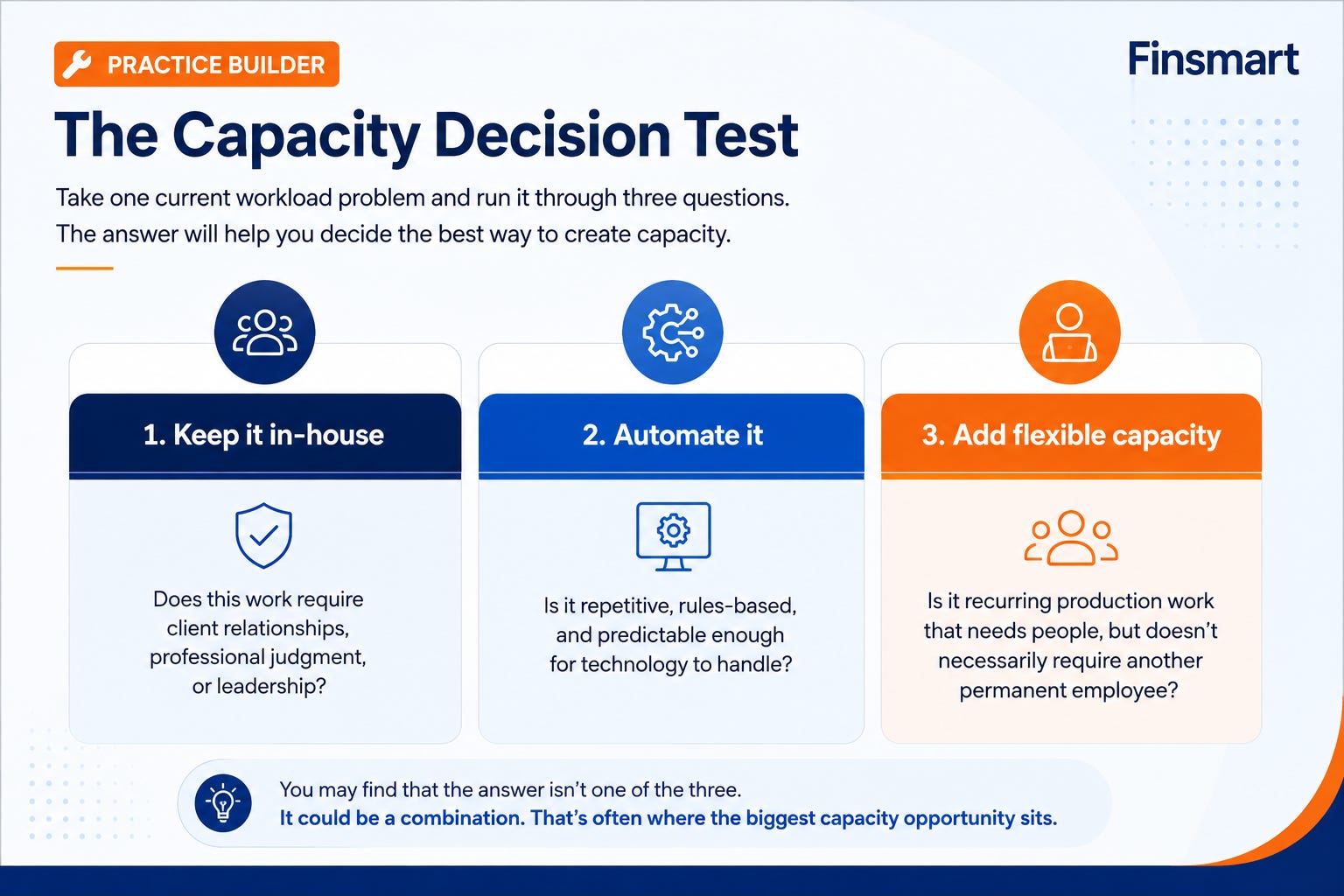
🛠 Practice Builder: The Capacity Decision Test
📚 Read This Before Making Your Next Hiring Decision

If your firm is currently weighing the cost and flexibility of hiring versus outsourcing, we’ve explored the decision in more detail in our latest guide:
👉 Hire an Accountant or Outsource in 2026?
The article looks at when hiring makes sense, when outsourcing can provide greater flexibility, and how firms can think about the decision based on workload, cost, expertise, and long-term growth.
It’s worth reading before your next job description goes live.
🚀Growth Requires a Different Way of Thinking About Capacity
For a long time, the equation was fairly simple:
More clients = more work = more employees.
That model worked when hiring was the primary way firms could add capacity.
Today, firms have more options.
AI can take on repetitive tasks. Automation can reduce manual work. Outsourcing can provide additional production capacity. And internal teams can increasingly focus on the work that requires judgment, relationships, and expertise.
The opportunity isn’t to eliminate hiring.
It’s to become more intentional about what you’re hiring for.
Because sometimes your firm doesn’t need another person.
It needs another way to get the work done.
💭A Final Thought
The next time your team says, “We’re too busy. We need to hire,” don’t dismiss the idea.
But don’t accept it automatically either.
Take a step back and look at what is actually creating the pressure.
You might discover that you need another accountant.
You might discover that you need better processes.
You might discover that automation can remove part of the workload.
Or you might discover that what you really need is flexible capacity that can grow with the firm.
The smartest staffing decision isn’t always the one that adds another employee. It’s the one that gives your firm the capacity it needs, when it needs it, without compromising the quality of work or the people delivering it.