
If your team is still catching up after tax season, you may not have a busy-season problem. You may have a capacity problem that busy season made impossible to ignore.
Let’s talk about something many accounting firm leaders don’t always say out loud.
The deadline has passed. But the team is still exhausted.
The returns may be filed, but the backlog hasn’t disappeared. Client follow-ups are still pending. Review work is moving slowly. Partners are involved in routine tasks, and the same employees who carried the firm through tax season are now expected to return to normal productivity.
Except there was never really a chance to recover.
And before the team has time to address what went wrong, the next cycle starts approaching.
So here’s the question worth asking:
What if your firm isn’t struggling because of busy season? What if busy season is simply exposing how your firm handles capacity?
The Problem Might Not Be the Volume of Work
Every accounting firm experiences periods of high demand. That’s part of the business.
But volume alone doesn’t explain why some teams continue struggling long after the busiest deadlines have passed.
The difference often lies in what happens behind the scenes.
A document arrives late. A task is assigned without clear ownership. A senior accountant steps in to correct an issue. A client sends information through a different channel, and someone has to manually reconcile everything.
One small inefficiency may not seem serious.
Multiply it across hundreds of clients and thousands of tasks, and it becomes a system-wide problem.
Look at what happens when work gets busy
Does the same person become responsible for every escalation?
Are senior accountants spending time on routine preparation?
Do client follow-ups depend on manual reminders?
Is work delayed because the next person doesn’t know what is expected?
Does the firm rely on overtime to meet predictable deadlines?
If the answer to several of these questions is yes, your team may not simply need to work faster.
It may need a better way to move work through the firm.
Your Team Can Be Busy Without Your Firm Building Capacity
One of the most common mistakes firms make is confusing a full calendar with a scalable business.
When demand increases, the immediate response is often to distribute more work across the existing team. If that doesn’t work, the firm hires. When the new team members need training, senior employees take on that responsibility too.
The result is a cycle that looks something like this:
More clients → more work → more pressure → reactive hiring → more management demands.
The firm grows, but the workload continues to fall on the same people.
This is where capacity planning needs to go beyond headcount.
Instead of asking only, “How many people do we need?” consider:
What work genuinely requires senior expertise?
Which tasks can be standardized or delegated?
Where does work repeatedly slow down?
Which processes depend on one individual?
How much additional client volume can the current structure realistically support?
The goal isn’t to avoid hiring. The goal is to make sure hiring is part of a deliberate capacity strategy rather than an emergency response to every busy period.
When Your Best People Become the Backup Plan
Think about your most experienced accountant or partner.
During a typical week, they may be responsible for complex reviews, client communication, team guidance, and business development. But whenever something goes wrong, they also become the person who steps in to fix it.
A missing document? They follow up.
A preparation issue? They review it.
A process breakdown? They take ownership.
A team member needs clarification? They answer it.
Over time, senior professionals can become the safety net for the entire operation.
This may keep work moving, but it comes at a cost.
Their time is pulled away from activities that create long-term value:
Developing advisory relationships.
Reviewing complex and high-risk work.
Coaching the team.
Improving internal processes.
Building new revenue opportunities.
Spending more time with clients.
If your most experienced people are constantly solving routine problems, who is working on the problems that will help your firm grow?
That is a capacity question—not simply a productivity question.
The Off-Season Should Be More Than Recovery Time
After tax season, the natural instinct is to catch up and move on.
But the quieter period is also the best time to examine the problems that became visible during the rush.
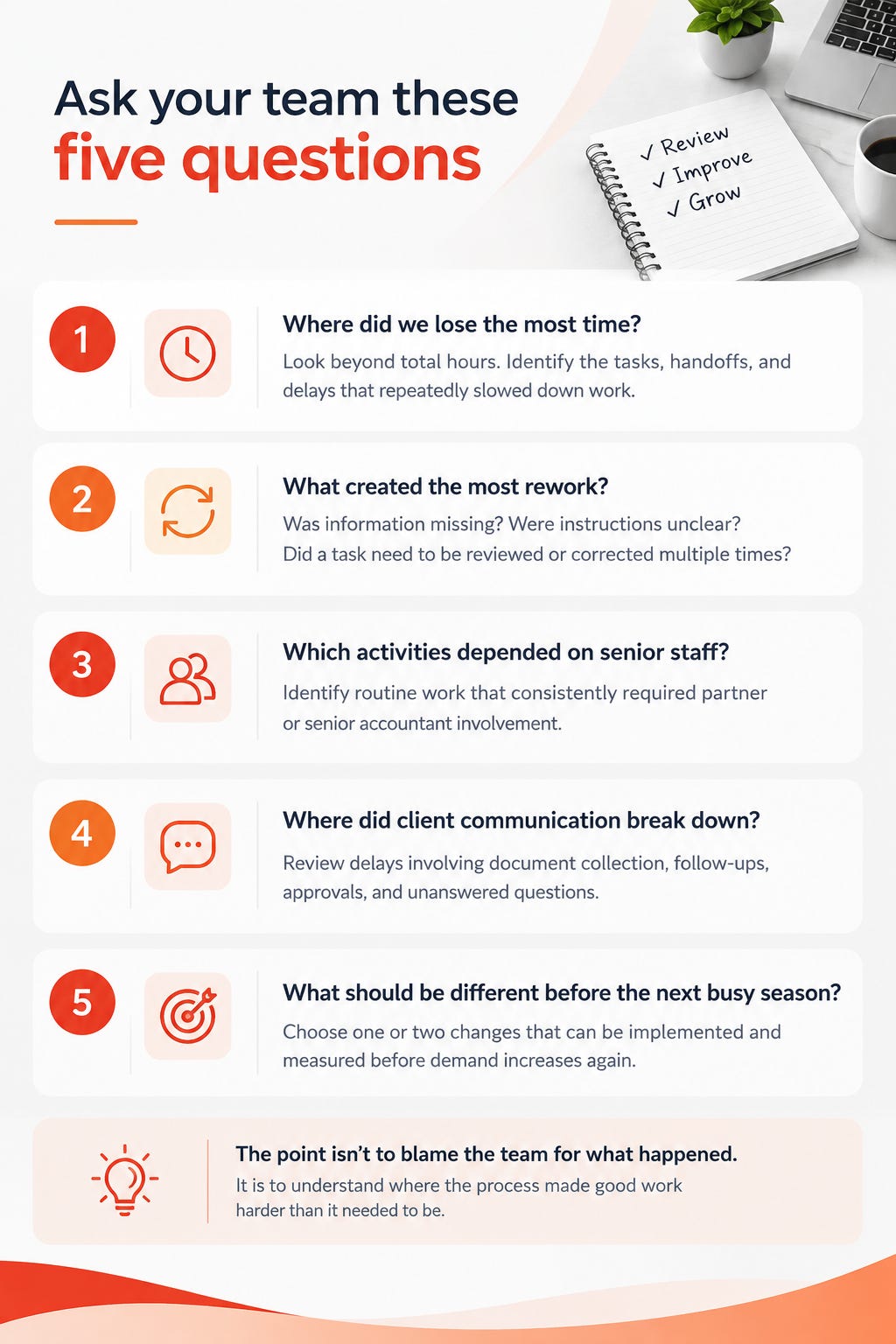
You don’t need a complicated consulting exercise to get started. A straightforward team review can reveal a lot.
More Technology Won’t Automatically Fix a Broken Workflow
AI is creating real opportunities for accounting firms. It can help with repetitive activities, document processing, data extraction, and other structured tasks.
But there is a difference between adding technology and improving the way work gets done.
If your team has unclear responsibilities, disconnected systems, inconsistent data, or no defined review process, another tool may not solve the underlying problem.
It may simply add another step.
Before introducing a new technology solution, ask:
What specific problem are we trying to solve?
Is the task repetitive and structured enough to automate?
Who reviews the output?
What happens when the system encounters an exception?
Does the tool integrate with the rest of our workflow?
Will it reduce work across the process or only in one isolated task?
The best technology strategy isn’t about using AI everywhere.
It’s about using it where it makes sense—and combining it with people who can apply professional judgment, handle exceptions, and maintain quality.
AI can help your team work more efficiently. But it cannot decide what a well-designed operating model should look like.
That responsibility still belongs to the firm.
The Capacity Conversation Needs to Include People, Processes, and Technology
There is a tendency to frame accounting capacity as a choice between hiring internally, adopting technology, or outsourcing.
In reality, these approaches can work together.
Technology can reduce repetitive work. Internal teams can focus on client relationships, complex reviews, and decision-making. Trained offshore professionals can support defined accounting and tax workflows, helping firms distribute recurring work more effectively.
The important part is having clarity around how the model operates.
A sustainable capacity structure needs:
Defined responsibilities across internal and external teams.
Documented workflows and consistent training.
Clear review and quality-control processes.
Appropriate data security and access controls.
Regular communication and performance monitoring.
Outsourcing is not a substitute for process improvement. And it should not be introduced simply because the team is overwhelmed today.
But for firms planning to grow, a dedicated offshore team can become part of a broader strategy to create delivery capacity without placing every additional task on existing senior employees.
Related reading

AI & Offshore Accounting Services for CPA Firm Growth
AI and offshore accounting support can complement each other when firms design their workflows around efficiency, expertise, and sustainable capacity.
Don’t Prepare for the Next Busy Season by Repeating the Last One
The next tax season will arrive whether your firm is ready or not.
The question is what you do with the time before it begins.
You don’t need to change everything at once. Start with one process that consistently creates pressure.
Maybe it’s document collection. Maybe it’s bookkeeping cleanup, tax preparation support, review work, or the way tasks are assigned across the team.
Choose one area and ask:
Can we make this process easier to repeat, easier to measure, and less dependent on one person?
That question can lead to better documentation, more effective training, improved technology use, or additional delivery capacity.
The aim is not to eliminate every difficult period. Accounting firms will always have deadlines, changing client needs, and fluctuations in demand.
The aim is to make sure that growth doesn’t automatically translate into exhaustion.
The Real Question for Accounting Firm Leaders
A successful busy season is not only about meeting deadlines.
It’s also about what the firm learns from the experience.
Did your team have enough support? Were senior professionals able to focus on high-value work? Did your processes hold up when demand increased? Could you take on more clients without placing additional strain on the same employees?
If the answer is no, the post-tax-season period is the right time to examine why.
Because your next busy season shouldn’t depend on everyone working harder than the last one.
It should depend on building a firm that is better prepared to handle the work.
Busy season may be over, but the lessons it leaves behind shouldn’t be. Use this time to identify bottlenecks, improve workflows, and build the capacity your team needs for the next cycle. The goal isn’t just to survive busy season—it’s to make the next one more manageable, efficient, and sustainable.