
Everyone Is Talking About AI. Few Are Talking About Work.
Over the past year, it has become almost impossible to attend an accounting conference, scroll through LinkedIn, or open an industry newsletter without seeing another headline about AI.
“AI will automate bookkeeping.”
“AI is transforming accounting.”
“The future of accounting is autonomous.”
The excitement is understandable. Firms are under pressure to do more with limited capacity, while clients continue to expect faster turnaround times and deeper financial insights. AI promises to solve many of these challenges, and in many cases, it already is.
But somewhere along the way, the conversation has become narrowly focused on the technology itself.
The more important question isn’t “What can AI do?”
It’s “What should accountants stop doing so they can create more value?”
That subtle shift changes the entire conversation.
🤖 Automation Is Excellent at Repetitive Work
Let’s start with what AI genuinely does well.
Today’s bookkeeping platforms can automate many of the routine activities that once consumed hours of an accountant’s day. Transaction categorization, bank reconciliations, document collection, and exception alerts can all happen faster and with greater consistency than they did just a few years ago.
That’s good news for firms struggling with capacity.
Removing repetitive work allows teams to focus on areas where professional judgment matters most.
Some of the biggest gains firms are seeing today come from automating tasks such as:
Transaction categorization and coding
Bank and credit card reconciliations
Receipt and document collection
Data extraction from invoices
Routine workflow reminders
These aren’t just efficiency improvements—they’re opportunities to redirect valuable time toward higher-value work.
The mistake isn’t adopting automation.
The mistake is assuming automation completes the job.
📊 The Moment AI Still Hands the Work Back
Imagine it’s month-end for one of your bookkeeping clients.
The software has already imported transactions, matched bank feeds, categorized routine expenses, and flagged a handful of unusual entries.
So far, everything is working exactly as intended.
Then a client asks:
“Why has our cash flow dropped this month when sales haven’t?”
Or perhaps a long-standing customer suddenly pays 45 days later than usual.
The software notices the anomaly.
But it can’t ask follow-up questions.
It can’t understand the client’s growth plans.
And it certainly can’t reassure a business owner who’s worried about what those numbers mean.
That’s where accountants become indispensable.
Technology identifies patterns.
People provide context.
Clients don’t remember the software that processed their transactions—they remember the advisor who helped them make a confident business decision.
⚖️ The Firms Winning with AI Aren’t Replacing Accountants
One misconception we continue to hear is that AI will eventually replace bookkeeping teams.
The firms we’ve spoken with are experiencing something very different.
Rather than reducing the need for accountants, automation is changing how accountants spend their time.
Instead of manually processing transactions, professionals are increasingly focused on work that clients genuinely value:
Reviewing exceptions instead of every transaction.
Investigating unusual financial trends.
Communicating insights to clients.
Supporting advisory conversations.
Solving business problems that software can’t interpret.
The nature of bookkeeping is evolving.
The role of trusted advisors is becoming even more important.
In many ways, AI isn’t replacing expertise.
It’s making expertise more valuable.
💡 The Finsmart POV
At Finsmart, we’ve always believed that technology should remove repetitive work—not meaningful work.
When firms combine standardized processes, experienced accounting professionals, and the right technology, they create something that’s difficult to achieve through any one of those elements alone.
They create operational capacity.
That’s a distinction worth making.
Capacity isn’t simply about processing more transactions or completing month-end closes faster. It’s about giving senior professionals the time to review thoughtfully, advise clients proactively, and focus on work that strengthens long-term relationships.
AI isn’t the destination—it’s an accelerator. Without consistent workflows and clear ownership, even the most advanced technology struggles to deliver meaningful results.
The firms seeing the greatest return from AI aren’t buying the most software.
They’re redesigning how work flows through the practice.
📚 Further Reading
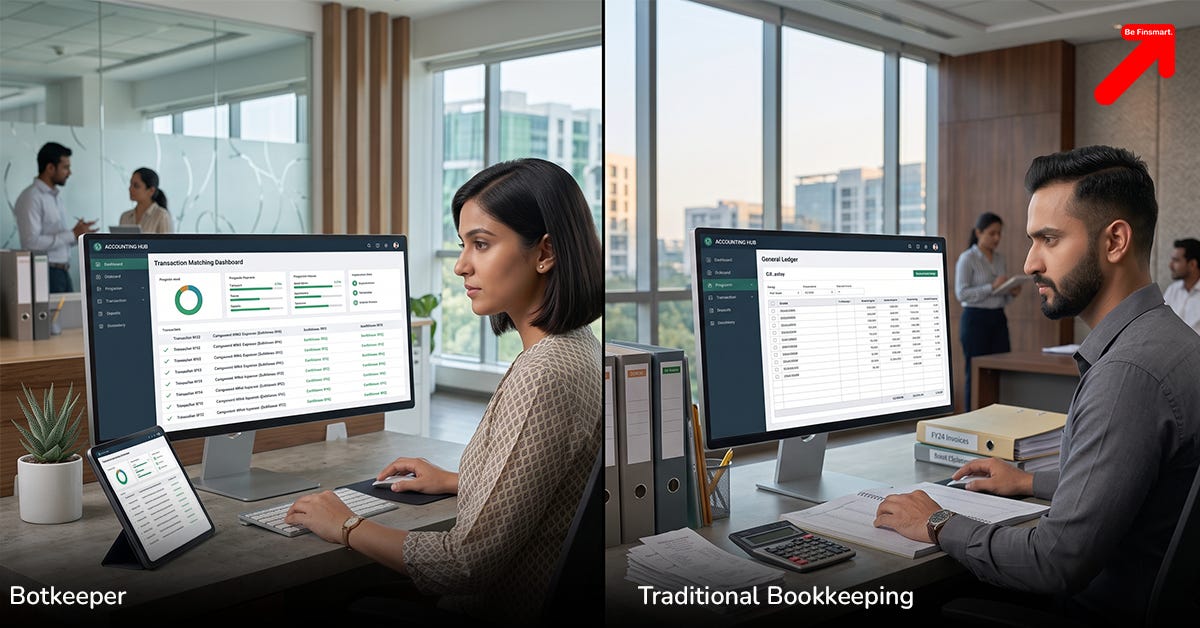
If your firm is evaluating AI-powered bookkeeping platforms, don’t start by asking which software has the longest feature list.
Start by asking where technology genuinely creates value—and where human expertise still makes the difference.
Our latest blog explores this in detail by comparing AI-driven bookkeeping with traditional approaches and examining why many firms are adopting a hybrid model rather than choosing one over the other.
👉 Recommended Reading:
Botkeeper vs. Traditional Bookkeeping for CPA Firms: Which Model Wins?
https://finsmartaccounting.com/blogs/botkeeper-vs-traditional-bookkeeping-cpa-firms/
🛠 Practice Builder
The AI Opportunity Audit
At your next leadership meeting, take ten minutes to review your bookkeeping workflow.
For each recurring task, ask one simple question:
Is this best handled by AI, a person, or both?
Consider these common activities:
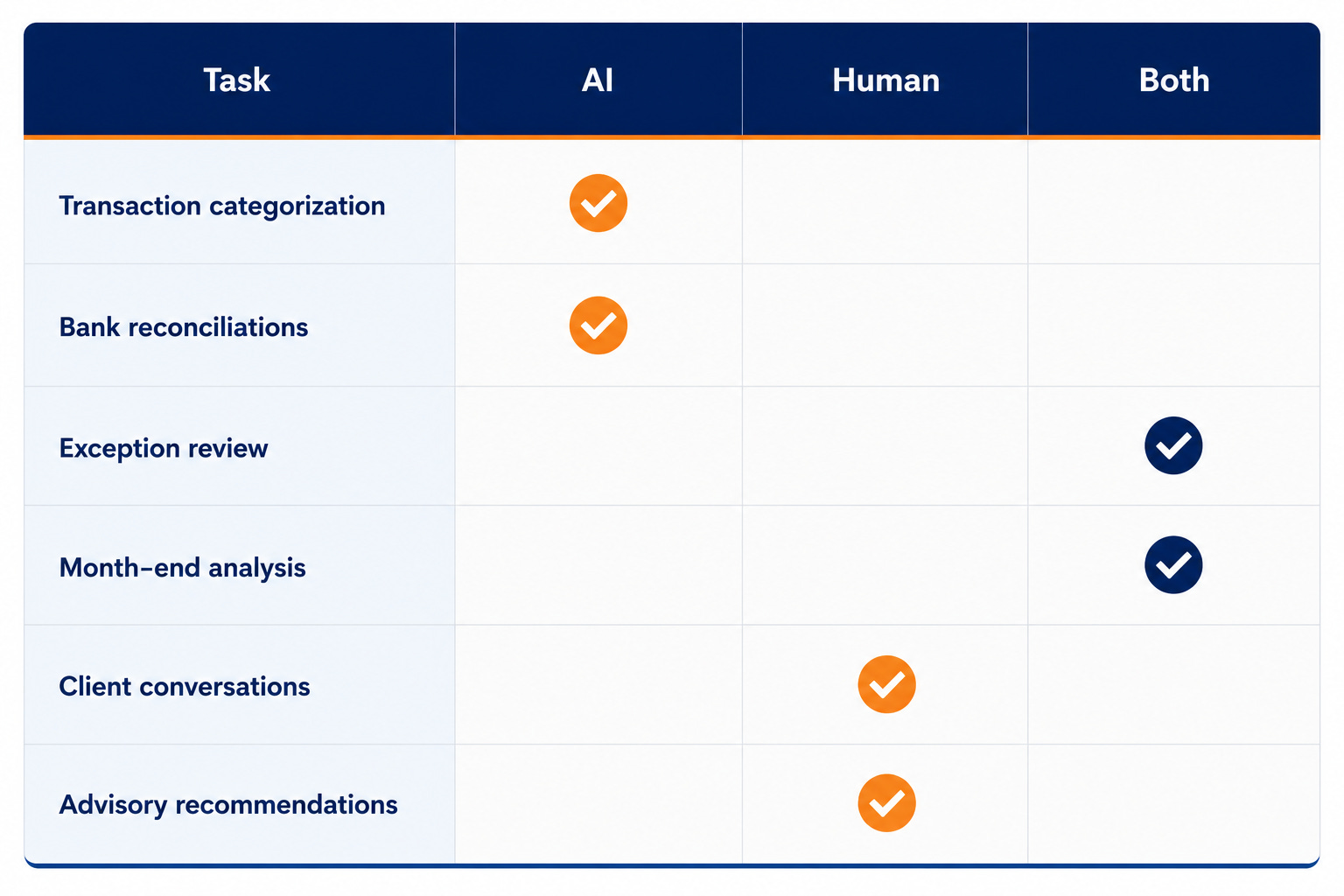
You’ll quickly notice a pattern.
The more routine the work, the more automation helps.
The more judgment the work requires, the more valuable your people become.
A Final Thought
Every major shift in accounting has followed the same pattern.
Spreadsheets didn’t replace accountants.
Cloud accounting didn’t replace accountants.
Automation didn’t replace accountants.
Instead, each innovation changed where accountants created value.
AI is no different.
The firms that benefit most won’t be those that ask, “How much work can AI take away?”
They’ll be the ones asking, “How can AI give our people more time to do the work clients value most?”
Because in the end, clients don’t stay because your software is faster.
They stay because they trust the people behind it.