
A partner walks into the office at 7:30 AM with a clear plan for the day. The goal is to finish reviews, clear client emails, spend some time on business development, and maybe even leave the office on time.
By lunch, the plan has completely changed.
A client can’t upload documents. A senior needs help with a complex return. A review comes back with corrections. Another client suddenly needs everything “today.” Everyone is busy, everyone is working hard, yet the backlog somehow keeps growing.
If this sounds familiar, you’re not alone.
This is why tax season feels chaotic. Not because the work suddenly appears, but because the pressure exposes every weakness in your firm’s operations. Tax season doesn’t create the cracks—it simply shines a brighter light on the ones that were already there.
⚠️ Why “Working Harder” Stops Working
When the workload increases, most firms respond the same way—they ask everyone to work harder.
The team puts in longer hours, weekends become the norm, partners review more returns, and managers juggle even more decisions. It often helps in the short term, but only for a while.
The reality is that effort has a limit. Once people are already operating at full capacity, adding more hours rarely creates more output. Instead, it often leads to:
More review delays
Higher chances of errors and rework
Slower communication
Burnout across the team
The problem isn’t that your team lacks commitment. It’s that your people are compensating for inefficient processes, unclear ownership, or workflow gaps. No matter how talented your team is, that’s not sustainable.
🚧 The Bottlenecks Were Already There
Busy season doesn’t create bottlenecks—it magnifies them.
A review delay that barely mattered in November suddenly creates a week-long queue in March. An unclear client request turns into multiple follow-up emails, and a manager reviewing every return becomes the biggest constraint in the workflow.
Consider two firms with almost identical teams. Both have around fifteen professionals and prepare roughly the same number of returns every season. Yet their busy seasons look completely different.
One firm moves work through the pipeline with confidence. The other spends every day asking questions like:
Where is this return?
Who’s waiting on the client?
Can someone review this today?
Why hasn’t this moved yet?
The difference isn’t capability or experience.
It’s visibility. Firms that know exactly where work is, who’s responsible, and what happens next spend less time chasing updates and more time delivering value.
This is also reflected in what the profession is seeing more broadly. According to the AICPA’s PCPS surveys and multiple industry staffing reports, talent shortages continue to rank among the biggest concerns for CPA firms. At the same time, more firms are recognizing that operational efficiency matters just as much as headcount.(Tax Preparation Outsourcing: The Smart Way to Beat Tax Season Burnout)
Adding more people can certainly help, but it rarely eliminates workflow bottlenecks if the underlying processes remain unchanged. Without clear workflows, defined ownership, and consistent review systems, even larger teams can find themselves struggling during peak season.
The firms that consistently outperform aren’t simply the ones with more people—they’re the ones that have built systems that allow work to move efficiently, even when the pressure is at its highest.
💡 The Finsmart POV
After working with accounting firms of different sizes, we’ve noticed one consistent pattern.
The firms that handle busy season most effectively aren’t necessarily the ones with the biggest teams. They’re the ones that have removed uncertainty from their operations.
They’ve invested time in creating systems that help work move efficiently by:
Documenting recurring processes
Defining clear ownership for every task
Standardizing review expectations
Reducing dependency on a single person for decisions
These firms create capacity through better operations, not just additional hiring.
Adding more people without fixing operational inefficiencies often increases complexity rather than productivity.
📊 Before You Hire More People, Measure Your Firm
When tax season becomes overwhelming, it’s easy to assume the solution is hiring more staff.
Sometimes that’s the right answer. But more often, the bigger opportunity lies in understanding where your existing capacity is being lost.
Ask yourself:
Are review cycles taking longer than they should?
Is work sitting idle between stages?
Are partners spending time on tasks that could be delegated?
Does your team always know what should happen next?
If you’re unsure, start by measuring your firm’s operational health.
🛠 Practice Builder
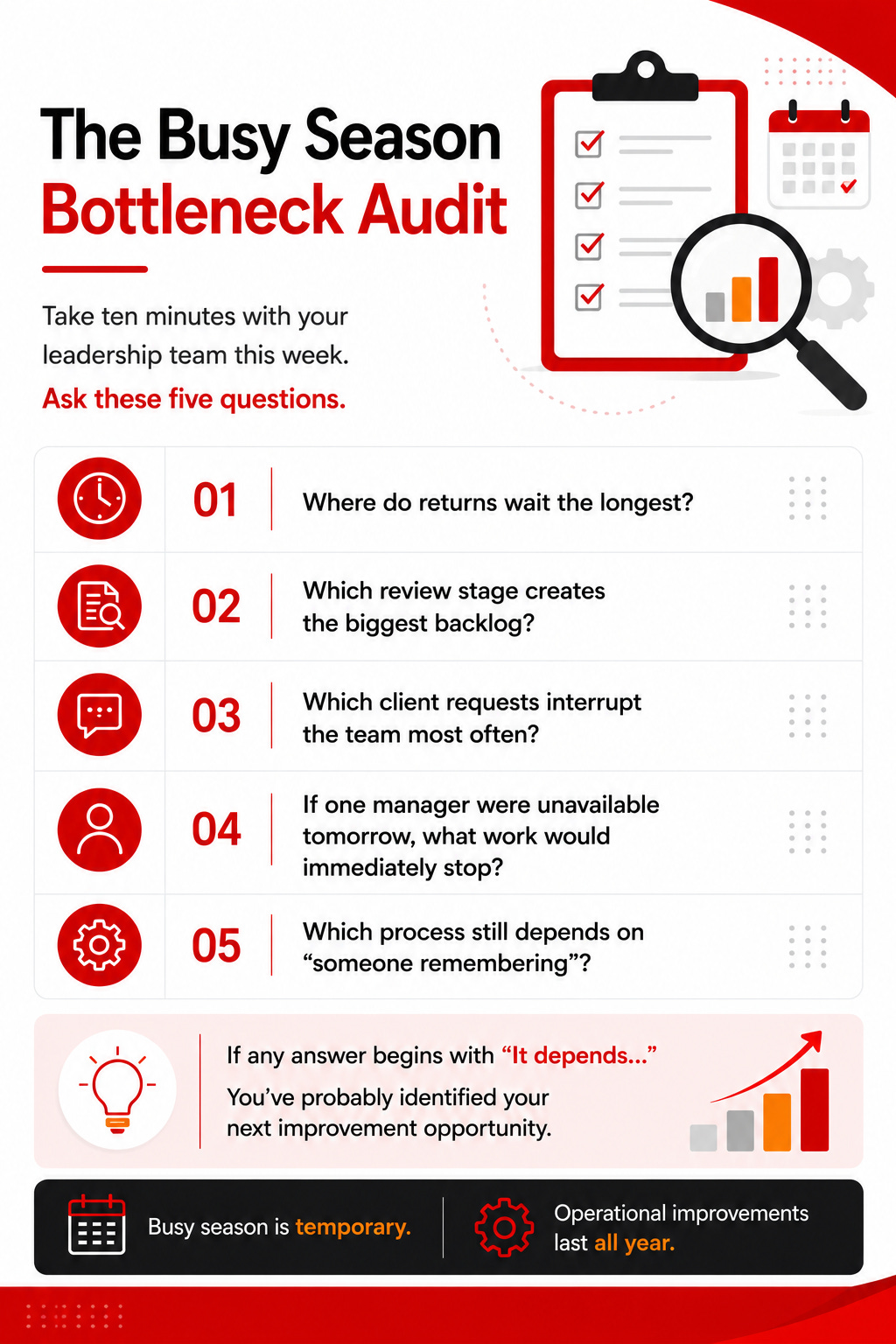
A Final Thought
Tax season is temporary, but the systems your firm depends on last all year.
Every challenge you’ve faced over the past few months has revealed something about how your practice operates. Some lessons may be uncomfortable, but they also present the biggest opportunities for improvement.
The firms that continue to grow aren’t the ones that simply survive busy season. They’re the ones that use what they learned to strengthen their processes, improve visibility, and build a practice that’s ready for the next stage of growth.
Because the goal isn’t just getting through tax season.
It’s making the next one easier than the last.