
AI is everywhere.
Every conference has an AI session. Every software vendor is launching AI-powered features. Every week brings a new promise about how technology will transform accounting.
Naturally, firm owners are asking the same question:
“How do we start using AI?”
It’s a fair question.
But after speaking with firm leaders over the past year, we’ve realized most firms are asking it a little too early.
The better question is:
“Is our firm actually ready for AI?”
Because the biggest AI myth isn’t that AI will replace accountants.
It’s that AI automatically makes accounting firms more efficient.
It doesn’t.
🛠️The Tool Isn’t the Transformation
Imagine two accounting firms implementing exactly the same AI solution.
The first firm has documented workflows, clear ownership, standardized review processes, and visibility into every engagement. Everyone follows a consistent way of working, making it easy to introduce automation into everyday tasks.
The second firm looks very different. Work moves through emails, Teams chats, spreadsheets, and memory. Every manager reviews work differently, partners frequently step into day-to-day decisions, and every client engagement follows its own path.
Both firms purchased the same technology.
Only one becomes significantly more efficient.
The reason is simple.
AI doesn’t redesign the way work flows.
It simply works within the system that’s already there.
When the process is structured, AI removes effort.
When the process is inconsistent, AI simply exposes those inconsistencies faster.
⚙️AI Can’t Fix Broken Workflows
This is where many firms get stuck.
Technology often becomes the first solution, when it should be one of the last.
Think about where firms lose time today.
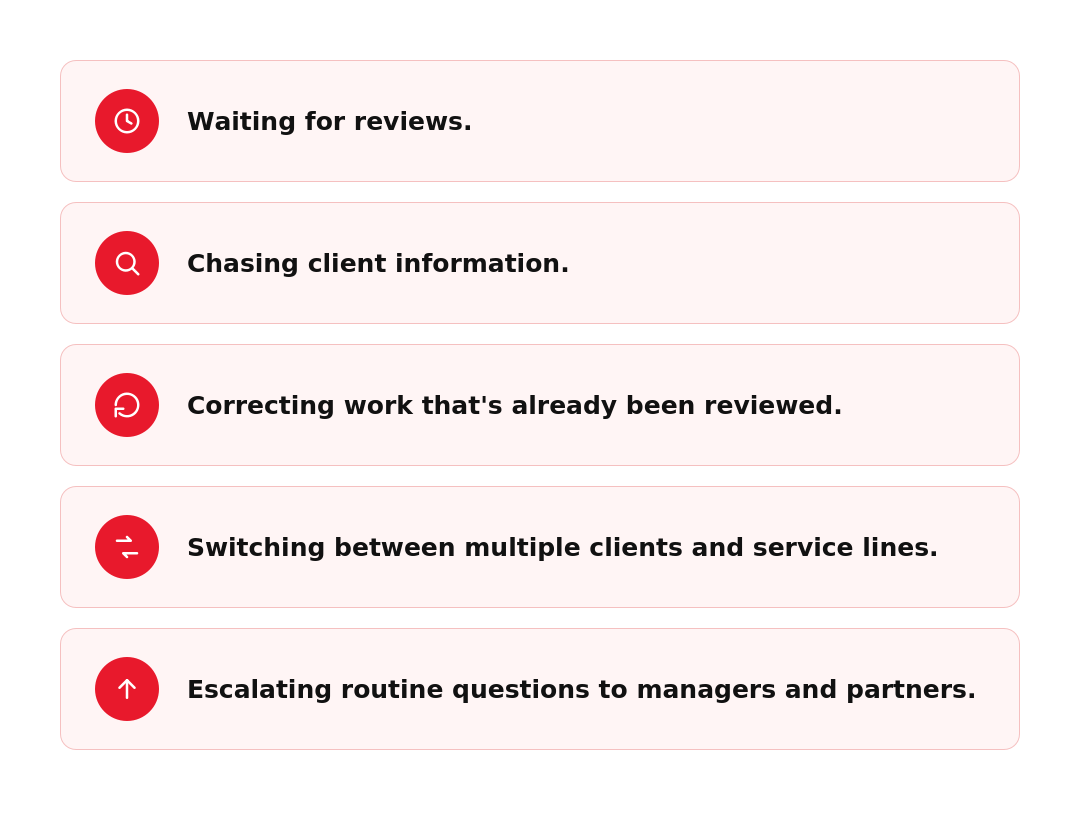
These aren’t technology problems.
They’re workflow problems.
Adding AI to an inconsistent workflow is a bit like installing a faster engine in a car with misaligned wheels. You’ll move faster—but not necessarily in the right direction.
Technology can accelerate work.
It cannot replace operational discipline.
↗️ The Finsmart POV
At Finsmart, we’ve always believed that sustainable efficiency comes from the combination of people, process, and technology.
Notice the order.
Technology comes last.
The firms seeing the strongest results from AI aren’t necessarily the firms buying the most tools. They’re the firms that first invested in standardized workflows, clear ownership, and consistent delivery.
Only then did automation begin creating meaningful efficiency.
That’s because AI is a force multiplier.
It amplifies good processes.
And it magnifies weak ones.
Instead of asking:
“Where can we use AI?”
We encourage firms to ask something different:
“What part of our delivery model creates the most friction today?”
Fix that first.
Then let AI amplify the improvement.
🛠 Practice Builder
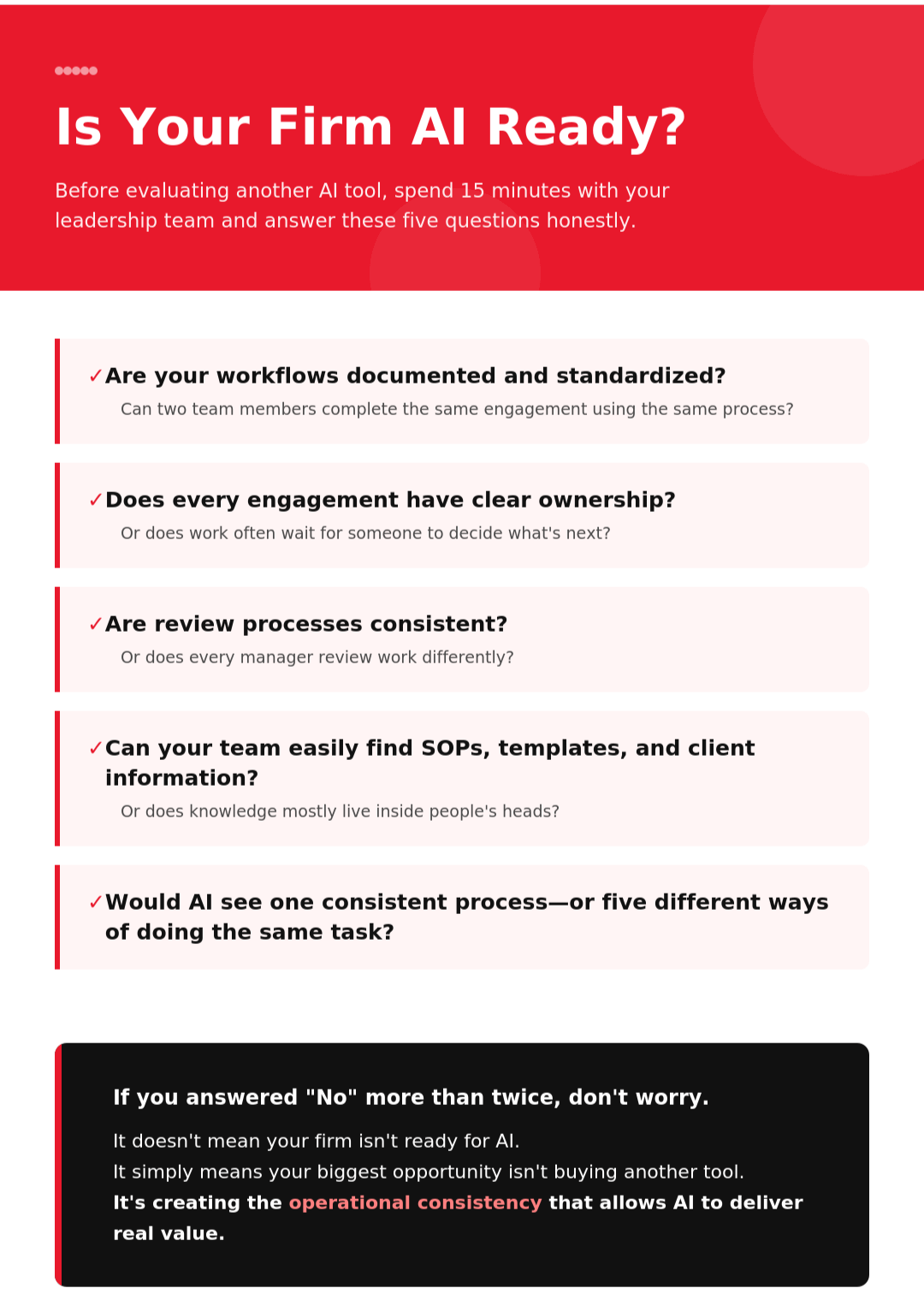
📊 Before You Invest in AI, Measure Your Firm’s Efficiency
One reason AI initiatives disappoint is that firms evaluate new technology before understanding how efficiently their current processes actually work.
That’s why we recently created the CPA Firm Efficiency Scorecard.
It’s a simple self-assessment that helps firms identify where operational friction exists—from review processes and workflow visibility to communication, ownership, and team dependencies.
Think of it as a readiness check.
Because before AI can improve a process, it’s worth understanding whether that process is already working the way it should.
👉 Read the CPA Firm Efficiency Scorecard
https://finsmartaccounting.com/blogs/cpa-firm-efficiency-scorecard/
💡A Final Thought
AI will undoubtedly change accounting.
But perhaps not in the way many firms expect.
The firms that benefit the most won’t simply be the ones with the newest technology.
They’ll be the ones that have built the strongest operating foundations for technology to build upon.
Because technology has always rewarded good processes.
AI is no different.
The future won’t belong to firms that automate everything.
It will belong to firms that know what to automate, when to automate it, and how to support it with the right people and processes.
Until next time,
Don’t ask how AI can replace your people.
Ask how it can help your people do their best work.
https://www.eventbrite.co.uk/e/ai-automation-for-finance-reshaping-finance-skills-for-next-3-5-years-tickets-1992478737540?aff=oddtdtcreator