
The Thought Experiment
Most firm owners want growth.
More clients.
More revenue.
More referrals.
More opportunities.
But here’s a question that rarely gets asked:
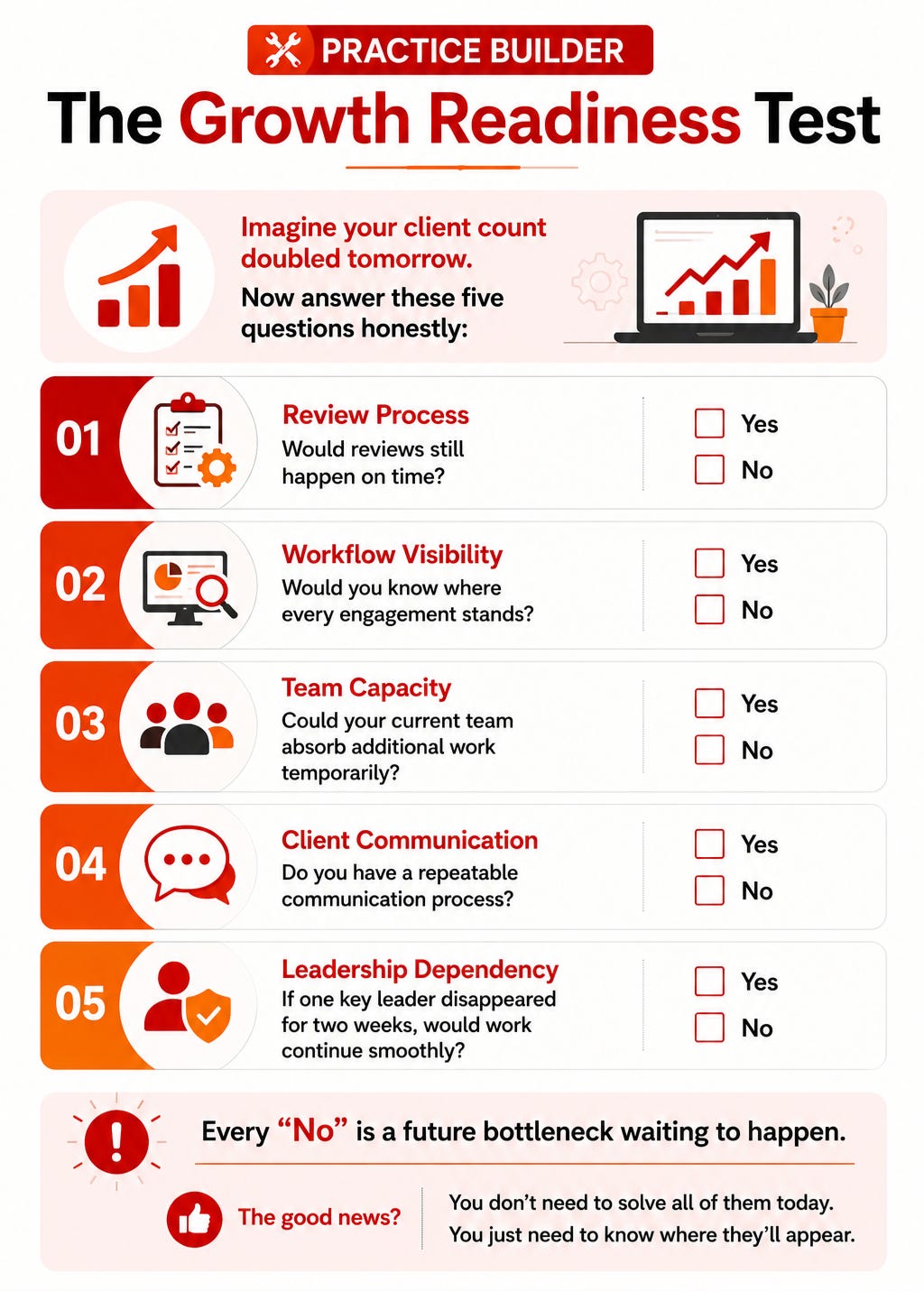
What would happen if your firm doubled tomorrow?
Not over five years.
Not gradually.
Tomorrow.
Twice the clients.
Twice the work.
Twice the deadlines.
Twice the expectations.
Most owners immediately think:
“That would be amazing.”
And it would.
For about a week.
Then reality would show up.
Because growth doesn’t expose your strengths.
Growth exposes your bottlenecks.
📈 Growth Doesn’t Create Problems.
It Reveals Them.
Most operational weaknesses stay hidden when business is manageable.
A spreadsheet works.
An informal process works.
A few heroic employees work.
A partner reviewing everything works.
Until volume increases.
Then suddenly the cracks become impossible to ignore.
The challenge isn’t getting more work.
The challenge is delivering more work consistently.
🚨 What Usually Breaks First?
1. Review Capacity
Most firms have an invisible dependency.
One partner.
One manager.
One senior reviewer.
Every important decision flows through them.
Every return.
Every financial statement.
Every deliverable.
When work doubles, reviews don’t magically happen faster.
The queue simply gets longer.
And suddenly growth creates delays instead of momentum.
2. Workflow Visibility
Ask most firms:
“Where is every client project right now?”
Many can answer.
Few can answer instantly.
As volume grows:
Deadlines become harder to track
Work gets lost between stages
Priorities become unclear
Teams start reacting instead of managing
What feels manageable today quickly becomes operational chaos.
3. Client Communication
Growth means more emails.
More follow-ups.
More document requests.
More status updates.
More questions.
Without a structured communication process, firms often find themselves spending more time talking about work than actually completing it.
4. Hiring and Onboarding
Most firms assume:
“We’ll hire when we need people.”
But hiring isn’t capacity.
Hiring is future capacity.
Finding talent takes time.
Training takes time.
Building trust takes time.
The firms that scale successfully usually prepare capacity before they need it.
Not after.
5. Partner Bandwidth
This is where many firms hit the wall.
Partners often become:
Chief reviewer
Chief problem solver
Chief client escalator
Chief decision maker
It works when the firm is smaller.
But if everything depends on a few people, growth eventually slows down.
Not because demand disappears.
Because leadership bandwidth runs out.
↗️ THE FINSMART POV
Many firms believe scaling requires:
More staff
More software
More clients
But the firms that scale consistently focus on something else:
Operational leverage.
They build systems that allow work to move without constant intervention.
They create processes that reduce dependence on individual heroes.
They design capacity before growth arrives.
Because scaling isn’t about doing more work.
It’s about delivering more work with less friction.
🛠 PRACTICE BUILDER
📅Upcoming Events
The next few months are packed with opportunities to connect, collaborate, and exchange ideas with accounting and finance leaders across the industry. Our team will be attending several key conferences and forums, and we’d love to meet you there.
Here’s where you can find us:
AICPA - Engage’2026
📍 ARIA Resort & Casino | Las Vegas📅 June 8-11
🎯 Booth — #326
👉 Let’s Meet at EventScaling New heights
📍 Orlando Marriott World Center, Orlando📅 June 14-17
🎯 Booth — #83
New Jersey Society of Certified Public Accountants (NJCPA)
📍 Borgata Hotel Casino & Spa, Atlantic City📅 June 16-19
🎯 Booth — #501
TXCPA - Texas CPA
📍 Centara, San Antonio📅 June 24-26
If you’re attending any of these events, we’d love the opportunity to connect and discuss how firms are rethinking growth, talent, and operational efficiency in today’s evolving accounting landscape.