

🧩 THE BIG SHIFT
The Work You Think Is Done… But Isn’t
For most accounting firms, this is how their work flows:
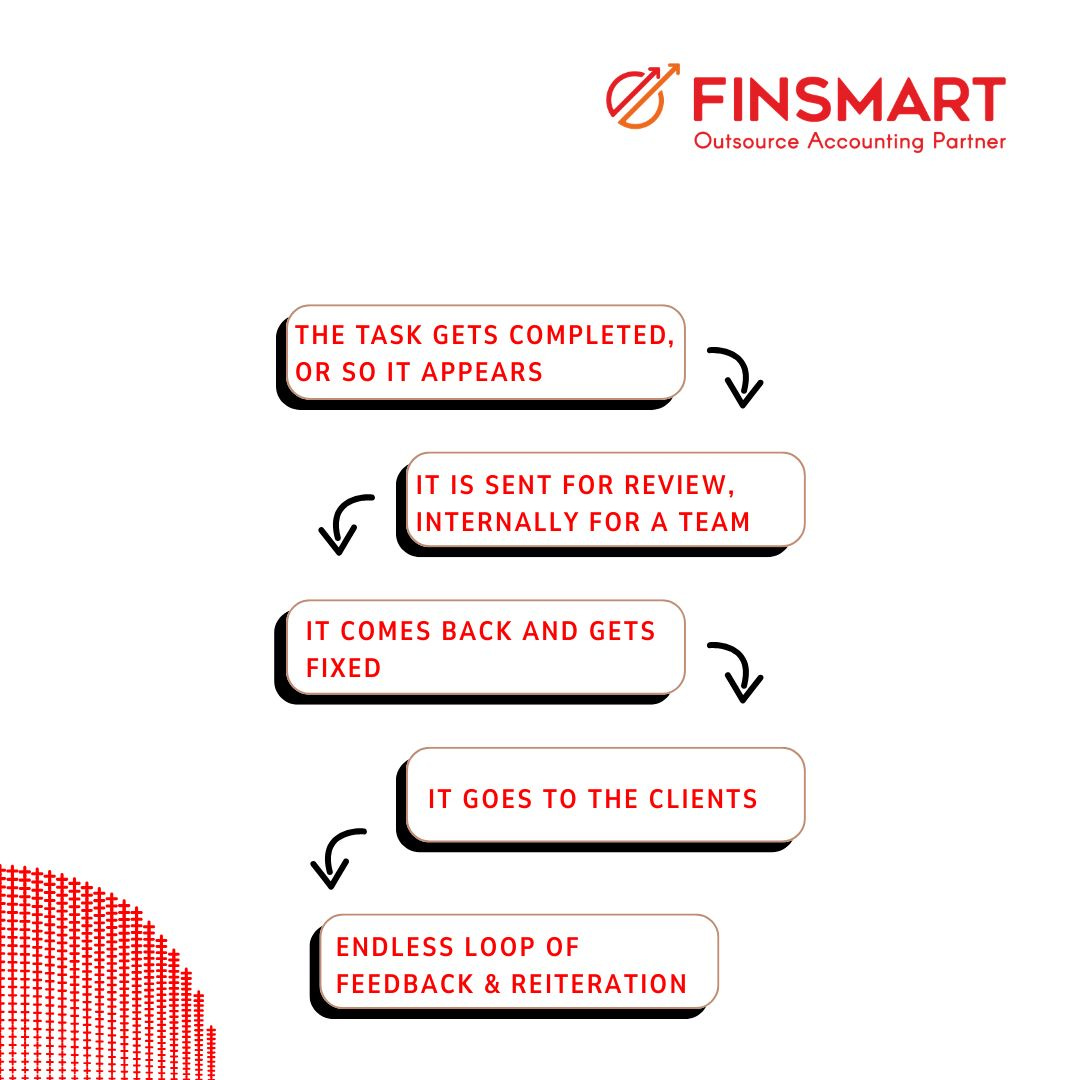
This goes on and on. Sometimes things get corrected. Sometimes, “it is the best that you can do.” Eventually, it gets delivered.
And everyone moves on. But in this entire process, there is something that no one tracks. And often that is the most harmful aspect for the business…
It is the number of times the same work has been touched. In most firms, one task isn’t done in one go. Two, three, sometimes four times is what it takes.
Over time, this becomes the norm.
“This just needs a quick fix.”
“Just a small change.”
“Almost there.”
But those “small fixes” are where your time disappears. The real cost in your firm isn’t the work you do.
It’s the work you redo.
🔎WHERE REWORK ACTUALLY COMES FROM
Rework doesn’t mean people are bad at their jobs. It simply means that there is something broken in the systems.
More often than not, the underlying problem is one of these:
No Clear Definition of “Done”
Things are often lost in interpretation. Every member has a completely different understanding and derivation of what “done” means.
So most of the time, when work reaches review, it is only “half-ready”.
Incomplete or Unstructured Inputs
The problem is not always with the doer. Sometimes it is with the one assigning tasks - missing documents, unclear briefs on what is expected, and so much more.
Teams end up making assumptions, and reviewers waste a lot of time correcting them.
Review = Correction, Not Validation
Reviews end up becoming fixing errors, rewriting the entire work, and redoing logic. What review should simply mean is validating the results that have already been created.
Feedback That Doesn’t Scale
On occasions where there are multiple re-do’s, feedback is verbal, scattered, and inconsistent. So the same mistakes repeat because nobody is keeping track of anything.
Rework isn’t random. It’s predictable - when the system isn’t clear.
⚠️ THE HIDDEN COST NO ONE TALKS ABOUT
The cost of rework isn’t evidently visible in your P&L. The impact is quiet yet profound.
It Eats Into Your Capacity
As a leader, you think you are making the best use of your resources in the most wholesome way. But in reality, your resources are spending so much of their time revisiting the same work.
It Burns Out Your Best People
High performers don’t mind working hard.
They mind fixing avoidable mistakes, repeating instructions, and unclear expectations. All of them, ultimately leading to acute burnout.
It Becomes a Growth Ceiling
Most firm owners think that more clients mean more work and better growth. That is not completely wrong.
But what they fail to realize is that more clients also mean more rework. So now growth starts feeling heavier.
It Pulls Leaders Back Into Execution
When quality is inconsistent, leaders are compelled to step in more.
And suddenly:
You’re not leading anymore.
You’re reviewing everything.
🧠THE SHIFT: FROM “MORE REVIEW” TO “BETTER REVIEW.”
Most firms respond to rework by increasing review.
More layers.
More checks.
More involvement.
But that’s not the solution. That’s compounding the problem.
The real shift is this:
Stop using reviews to fix work.
Start using reviews to protect quality.
A strong review system should:
Catch edge cases
Validate output
Ensure consistency
Rebuilding from scratch is not a doable option. And for that to happen, the review itself needs:
Structure
Clarity
Ownership
🪑REVIEWER SEAT TO SMOOTH AVOID IT ALL
Most firms struggle with reviews. But what they fail to understand is that review is not a role. It is an overloaded responsibility.
And that’s where things break.
At Finsmart, we’ve seen this across firms, which is why we built what we call:
👉 The Reviewer Seat

With the Reviewer Seat, you get:
Experienced Reviewers: Senior accounting professionals with 8+ years of experience ensure thorough financial oversight.
Enhanced Accuracy & Compliance: Reduce errors, maintain compliance, and improve financial clarity.
Free Up Leadership Time: Shift financial review tasks to experts so firm owners can focus on strategy and growth.
Streamline Year-End Processes: Get audit-ready financials and tax compliance without last-minute stress.
This isn’t about adding another step. It’s about removing unnecessary loops.
Because when the review is consistent, structured, and owned, rework drops.
And leaders get their time back.
Know more about the Reviewer Seat here: https://finsmartaccounting.com/services/cpa-accounting-firm/cpa-reviewer-seat/
🛠 THE PRACTICE BUILDER
The “Rework Audit” (Try This This Week)
If you want to see how much rework exists in your firm, try this:
1. Pick 5 Recently Completed Tasks
Any recurring work:
Bookkeeping
Tax prep
Monthly reporting
2. Track the Touchpoints
Ask:
How many times was this reviewed?
How many revisions were made?
Where did it go back?
3. Identify the Trigger
Why was it reworked?
Unclear instructions?
Missing inputs?
Quality gaps?
4. Fix Just One Pattern
Don’t try to fix everything in one go. Fix one recurring issue:
Define “done”
Standardize inputs
Document feedback
The goal isn’t perfection.
It’s reducing repeat effort.

🌍 A LIVE PANEL TO ADDRESS BURNOUT - A FINSMART POV
One of the major consequences of consistent re-do’s is burnout.
Most firm owners think that issues like multiple reiterations can only be resolved when the teams work for longer hours.
The debate of how many hours accountants should work is and always will continue to be a debate until we know how to do it right.
At Finsmart Accounting, we are conducting a webinar on “30-hour work week: Fantasy or a Leadership Choice?” today at 1 PM EST.
This live panel will be conducted by Maanoj Shah, Co-Founder at Finsmart Accounting, with Sharrin Fuller, Randy Crabtree, and Debra Kilsheimer, where they will talk about:
Why most firms struggle to escape the long-hours model
The operational decisions that determine workload and capacity
How firm leaders rethink staffing, technology, and client work
What changes when firms start designing for sustainability
If you still haven’t registered yet, register now: https://finsmartaccounting-242729172.hs-sites-na2.com/30-hour-work-week
If your team is busy but growth still feels hard, look closer.
You might not have a workload problem. You might have a rework problem. And the fastest way to scale isn’t doing more work. It’s stopping the same work from being done twice.
See you next time!
Ten years in accounting and rework was the most consistent line item nobody reported.
This hits on a very real issue, rework often hides in plain sight and quietly erodes capacity. The point about unclear inputs and definitions of “done” is especially important. Tightening those upstream elements can often do more than adding layers of review.